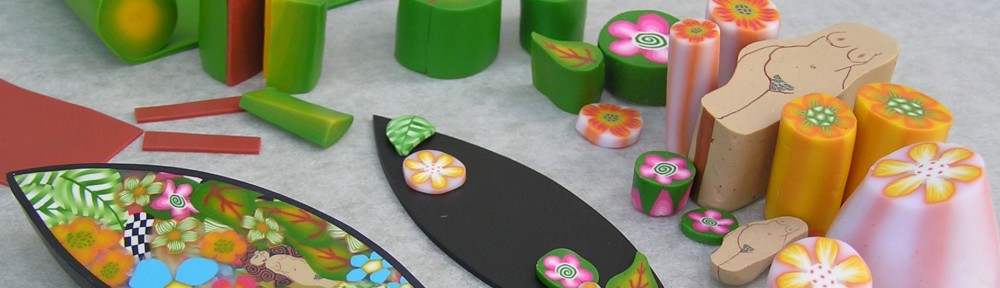
‘Naked’ polymer clay – the rewards of limiting tools and materials

Whether you’re wondering where to start, teaching beginners, or just wanting to fire your creativity, it’s worth considering what few tools and materials you really need.

Polymer clay is an amazing material – there are so many techniques and endless tools available – it can all be overwhelming. 

There are good reasons to limit your tools and materials.   

  • Reduced cost
  • Reduced waste
  • You can find out if you like the material before spending more money
  • If teaching – you can teach a class of beginners and keep costs low
  • You can work out what additional supplies you really need, and add gradually to your collection.

However, another benefit is that constraints can encourage creativity and even help us get over the “where do I start” block.

I don’t make pieces to sell, and have used polymer clay as my ‘meditation’ – as a break from my day job in community work before I retired.   So, this approach is probably not economical, but it might help you approach polymer clay in a way that encourages mindfulness, and helps develop your creativity. [Of course this is the aim – in real creative life I’m often stuck, impatient and cross when my pieces don’t turn out!]

All the pieces above are made using only: 

  • A roller
  • A blade
  • A craft knife; 
  • Polymer clay in 5 colours – yellow, blue, magenta, black and white;
  • rubbing alcohol for cleaning surface and tools; and
  • Some items I had around the home.

One additional item which I couldn’t do without is my pasta machine. It certainly speeds things up and saves my hands, but you don’t need one to get started unless you have issues with your hands. Most of the techniques I use could be done without a pasta machine, and some well known artists including Layl McDill and the late Tory Hughes taught classes without using pasta machines.

I love working with the colours of the clay itself, rather than adding paint or inks.  Mixing colours from just a few original colours can result in a more cohesive colour scheme.  The technique used can also change the colours – for example in the mokume-gane earrings above I have only used a light orange, magenta, black and white, but the blending of those colours due to thin layers introduces a green colour.

The earrings here have been made with the tools and clay colours above, but using the pasta machine

I plan to share some of the basic techniques here in the future.

I taught a 5-day polymer clay class

I recently taught a polymer clay course to11 students, over 5 days, at the TAFTA live-in textile art retreat at Geelong (Australia).   I was one of 10 tutors – students choose one course which they do for the full week.  I haven’t taught anything like this before, so this involved a lot of planning.

I have attended the TAFTA retreat annually as a student for many years, but polymer clay has not often been taught (most recently in 2017 when Tory Hughes was the tutor, shortly before she died).

My students ranged from full time artists (in other media) and art teachers to those with little experience.  None had much experience – if any – with polymer clay.

 The classes at this retreat traditionally teach students various techniques, and while some design guidance is provided, students are encouraged to take the techniques in any direction they choose.   You can see by the photos above how wide-ranging the student work was.

A key theme of my class was recognising, and using, the colour properties of the polymer itself, rather than using surface treatments.

Students only brought Premo in black, white and three primary colours.  We spent a full day planning an individual colour scheme, mixing colours and making blends.

Over the next few days I demonstrated various construction techniques, canes and mokume gane.  Feedback from the students, and others who saw our work, was very positive.

I also did a short presentation to the (about 100) event attendees, explaining the variety of colour and pattern effects that can be achieved, showing pictures of my work and that of my favourite polymer clay artists, including Kathleen Dustin and Jeffrey Lloyd Dever.  The feedback from the audience, most who take a keen interest in textile and other art forms, was that this was a real eye-opener, showing that polymer clay is a highly versatile art material.

Mokume-gane

Polymer clay presents so many ways to use just the clay itself (without paint etc) to create complex color blends and designs.   

The Mokume-gane technique involves (usually very thin) layers of clay stacked, and impressed with deep stamps, texture sheets or household objects such as knitting needles, pen tops, and various hardware.  (The name is based on an ancient metal technique which involves patterns created by cutting into thin layered metal sheets)

Once impressions are made, very think slivers can be removed with a flexible blade, so you can use the sheet of pattern that remains as well as the slivers you’ve removed.

Continue reading

Fabric inspired earrings

I made a pair of trousers from this wonderful fabric, designed by ‘Miss Moresby‘, and decided to use this design as inspiration for some polymer clay earrings.

Continue reading

Name badges

Returning to the office a year ago after a few years of working from home – and with some continuing to work from home part-time – it was difficult to remember colleagues’ names – particularly new staff who’d commenced during COVID.

Making some name badges people would like to wear was an answer.

Continue reading

Another Dan Cormier workshop

I recently finished another online course with Dan Cormier, this time making vessels. The course was about construction, and we had to create our own veneer. As always, there was a focus on exacting work, which is a great discipline.

I’ve since made a film container for someone who is using an old ‘box brownie’ camera. I was aiming to create a mid-century design based on the shapes in my leather cutter set. These cutter sets are quite cheap – search eBay or similar for “leather cutters”.

Two workshops – two very different approaches

We’ve had over 200 days of lockdown in Melbourne, and I’ve been hosting online ‘crafternoons’ with friends since April 2020.  The COVID pandemic has meant much more use of video meetings, and I doubt I’d have been able to attend a Ford and Forlano class in ‘normal’ times.

I did two workshops this year – both were great but different in many ways.  I did Dan Cormier’s Building Better Beads.  This is the third course I’ve done with Dan – you choose when you read the materials and watch his videos which are posted over the 4 weeks. You can post pictures or questions and receive comments back.

Here are my two finished pieces from Dan’s course.

Continue reading

Knotted rope cane

I love watching Philip Wiegard’s youtube videos – whether you want to make any of the canes or not, they can be mesmerising.

I recently made one of his knot canes. Check out his video for step by step demonstration. I made a couple of brooches (pins), covered an egg (why not?) – now thinking about something to do with the rest.

Polymer Clay Eggs

An alternative to chocolate eggs – but not as tasty!

The eggs are blown out and usually covered with liquid polymer clay (which you can do as you go).

There are many techniques for covering eggs, depending on the look you want, and/or the designs you start with.  You can start with any polymer clay design – plain metallic clay, sheets of patterns or some canes.

The gold one is the simplest, just roll a sausage of metallic clay, take some slices and push them onto the egg.  Depending on how thick the slices are, and how you place them on, you will see various ‘mica shift’ patterns.

Philip Wiegard covers a Christmas bauble here, but shows how you can ‘shrink’ a sheet of polymer clay to shape it around a sphere.  Check out his other videos, I love his quirky and complex canes.

Fiona Abel-Smith covers a goose egg in this tutorial using a different technique. 

The top 3 eggs were covered by cutting 1/6 segments that narrow at the top and bottom (like the segments of an orange).  Fiona covers a Christmas bauble here. I followed this technique (covering alternative segments, baking then filling in the other segments) for the one at the top LHS corner, although I need to get my measurements more accurate and improve the joins.

Check out Fiona’s amazing bowls while you’re on her channel.

For the 3D block egg (my favourite), I added the cane slices then baked the egg.  Once cool, I wrapped it in the grey and gradually cut out ‘holes’ for those slices and smoothed the joins.  A technique I first did with Sarah Shriver, a technique she calls “reverse inlay”.  

Scrap clay techniques

There’s no such thing as scrap clay – well not for me – I find so many things to do with clay left over from projects I rarely have much scrap.

If you make items to sell it may not be economical to look for ways to use scrap.  However, if you do this for pleasure like I do, and make items on a small scale you might find working with your scraps helps fuel your creativity.  

Here I make suggestions for all levels of scrap, from left-over canes to those muddy clumps of clay. 

Here’s my video of the ‘Totem’ / Micro-Natasha technique mentioned below. [I’ve heard since that the term used for this technique is ‘scrap-scape’]

Left-over canes

Kaleidoscope canes

Lengths of these canes were combined to make the new cane (bottom left).

Kaleidoscope canes are great if you have excess canes, or have canes you just don’t like.  To get the repeated pattern, all components need to be consistent for the length of the cane, so are good for canes you have no more use for – even canes you think are ugly can look great when combined in a kaleidoscope cane.  You can also add long ‘sausages’ or strips of a color.  You’ll find a lot of tutorials for these, or  See my steps in making a kaleidoscope cane from left over canes and also here.

Continue reading