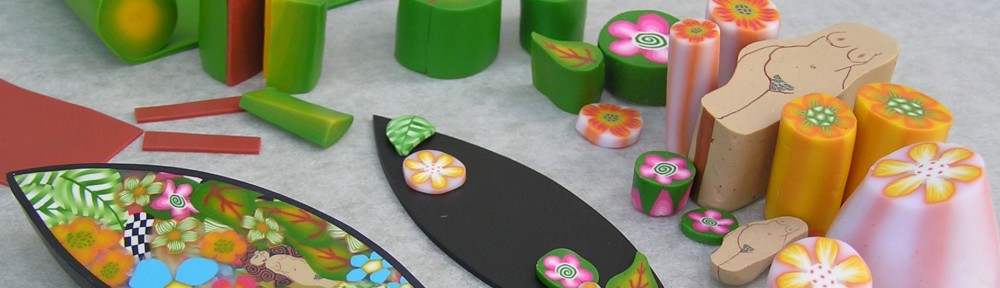
Making your own colour scheme can enhance the individuality of your work. While you may want to learn a lot more about colour, you could find that the following approach can help you build your own cohesive colour scheme straight away.
Create a basic colour scheme

You will:
- work with three packet colours only, plus black and white (believe me, this is easier that starting with more packet colours)
- follow some basic steps to create a colour scheme without trying to match, or create, specific colours
- make changes (if needed) to one or more colours until you’re satisfied.
Here are the steps I followed to get to the colours I used in the dish pictured above. Your initial scheme will have quite ‘clean’ colours, meaning no muted/muddy colours such as browns. However this is a good start for any scheme, and I explain below how to add some muddy colours to your scheme (such as brown, olive green, mustard yellow).
Step 1 – choose three packet ‘primary’ colours
Choose three packet clay colours that are exactly, or similar to, the three CYM primary colours.
The colours marked C Y and M below are the primaries, from which you can mix almost any colour (think about your inkjet printer with 3 colour tanks plus black). Three Premo colours are quite close to the primaries – cobalt blue, zinc yellow and fuchsia (marked below with *). However, any colours in any brand that are similar will work. The colour wheel gives some idea about the results of mixing any two of your colours together – so for example yellow and fuchsia will result in oranges or reds.

Step 2 – mix 2 packet colours
Take two of your three colours (let’s call them colour 1 and colour 2) and mix different proportions to create 2 or 3 new colours. Proportions are important. Try a 50/50 mix, then try 20 parts to 1, which will give you an idea of the strength of each colour. Think of the resulting colours as the main colour group for your scheme, although you can change this later.
Step 3 – mix contrast colours using the third packet
Make one or two colours by mixing just two colours at a time, but this time include the third colour – so mix colour 1 and 3, and colour 2 and 3. This should form some contrasts to your first set of colours. Alternatively you may want one of your contrast colours to be one of your packet colours (for example blue or yellow).
Step 4 – check for contrast and finish your colour scheme
Look at your new colours and see if there is enough contrast. It’s good to have some colours that are similar, but some contrast is important for a lot of polymer clay techniques. Consider:
- hue – the actual colour, for example yellow and purple are a strong contrast
- light/dark – imagine a black and white photo of your colours – would you see strong contrast
- clean v muddy (muted) – are some colours ‘clean’ (eg a bright green) and other colours muddy (eg olive green, mustard or brown).
- proportions – are you using different proportions of each colour in your work?
To lighten colours
You may want to lighten one or more colours to increase contrast. Generally you can do this by:
- adding yellow to a colour that contains yellow (reds, oranges or greens) or
- adding white to colours such as blues and purples.
Example
I used Premo cadmium yellow (CY), ultramarine (U and fuchsia (F). My first mixes were CY and U.

I mixed:
- 50 parts CY to 1 part U
- 12 parts CY to 1 part U
- 3 parts CY to 1 partU
These are not recipes, but a guide to what you might expect. (Colours change a lot due to camera, lighting and computer screens)
Note how strong the U is compared to the CY. Using half and half would resu a very dark green. You can ‘eye ball’ your amounts, but I cover how to measure proportions below.

For my contrasts I mixed:
- 1 part F to 4 parts CY
- 1 part F to 8 parts CY
- 4 parts F to 1 part U
After looking at the colours together, decided I needed another light colour. I mixed the purple colour with some white. Here is my colour scheme with black and white added, and showing how I might use different proportions in a piece. Colour schemes rarely look good if you just set out equal amounts of each colour. A general rule to start with is to use 60% of your main colour, 30% of your first contrast and 10% of your second contrast


Another example
For this scheme I started mixing magenta and yellow, resulting in a very light orange and a mid orange. My contrast colours were blue (cobalt blue packet colour third from the left) and magenta/purple. I decided to make blue the main colour, so I added white to the blue in different amounts to give me a range of blues, and made a darker blue by adding a small amount of black. I also included some white in the scheme. I’m not sure if the magenta/purple works, but it may look good if used in small amounts.


Key tips
- See what colours develop rather than trying to match a particular colour scheme
- Don’t start with more than three colours (+ black and white)
- Once you have a colour scheme you like, stick with it for a while – you probably don’t need to mix a new scheme every time you make something
- If you have a pasta machine or small scale you can measure and document your recipes
- Some clay colours are very strong, so try using smaller amounts of the darker colour for example use 1 part blue to 20, 50 or even 100 parts yellow
- Contrast – in most polymer clay work good contrast is important. Check to see if there’s enough contrast in your colours
Take your colour scheme further
If you started with the primaries, or very close to the primaries, your colours will tend to be pure (clean). This means the colours are bright and clear, so you won’t have very muted (or muddy) colours such as mustards, olives or browns.
I’m often happy with quite clean colours, particularly as techniques such as mokume gane can muddy up the colours when very thin layers blend in the process.
However, if you want to take your scheme further, this is how I worked my green/orange scheme above to create a more complex scheme, including more muted colours.
Step 1 – alter one or more colours
This part involves playing around altering one colour at a time to see what fits in. One slightly different colour can make a big difference to your scheme. I only changed two colours in the end, but I tested a few mixes before I was happy.
I decided I wanted to try some browny colours, and also add one or more light contrasts.
To mute (muddy) a colour, you can add a small amount of black. If that darkens the colour, add some white as well (using twice as much white as black can prevent darkening). However, I prefer to mix in a colour that is on the other side of the colour wheel – it doesn’t need to be exactly opposite. Note that two colours that are somewhat opposite on the colour wheel make a muted colour when mixed together. So I decided to aim for some browns by adding a little U to my original oranges. It only needed a small pinch to turn the orange to brown.
Step 2 – play around until you are happy with your new scheme
I decided that I liked the three colours in the right hand picture.
I made a much lighter orange by mixing 1F to 50 parts CY.
The mid brown and dark brown are both made by adding a small amount of U to my original oranges.
4CY, 1 F and 1 U (middle) and 8CY, 1F and 1/2 U (bottom).

After playing around with my new colour samples, I decided to keep the original greens and purples, but to replace the original oranges with the new lighter orange and dark brown. I usually use some black and white as well to my work, so I’ve included that.

If you alter the proportions in your work, the one colour scheme can look quite different. For example, the orange and brown could be the major colours, using greens and purples as minor contrasts.
Measuring and recording
You don’t need to measure your colour mixes exactly, and you can do some by eye (for example mixing 1/2 a packet of one colour with 1/4 packet of another. However, more accurate measurement can be important if mixing more extreme proportions (as below) and enable better record keeping if you want to record your recipes. Some options for more accurate mixing:
- Roll packet colours to the same thickness (using a pasta machine). Use a cutter to measure amounts. Using all 12 yellow squares and the quarter of a blue square would give me 48 yellow to 1 blue.
- Use a small scale – available cheap online. I have 0.51 (about half) a gram of blue. 24 gram of yellow would also give me 48 yellow to 1 blue.
- Using some graph paper (preferably under a translucent surface). The mix in the picture would be about 96 yellow to 1 blue.


I make samples of all my colour mixes, and record the recipe on the tile. I then have a box of tiles to play with if I want to create a new scheme.

Colour resources
BreakThrough Colour – While not only for polymer clay artists, many members of Tracy Holmes’ Colour Room work with polymer clay. A great way to get more confident with colour.
Joan Tayler sells some colour resources that are specific to polymer clay on her Etsy site. Her colour lines show the range of colours you can achieve by mixing just two colours. Her instagram shows her ‘4 packet challenge’ where she made a scheme from 4 random packet colours.
The Blue Bottle Tree Insiders Community is a great resource for anything polymer clay, including articles and videos about colour.


